
Mysteries of the Check Engine Light, Not Bike Related, I just had to write something

     I'm a mechanic, so by my nature I like to know how things work. I get a feeling of joy when I see how the magic happens. When you first get the itch to try repairs yourself there are many magical obstacles before you. For example, look at changing gears on a bike. You are pedaling a bike, you move the lever on the bar *POOF* magic happens! and now the bike is pedaling easier up the hill. 

    But then you spend a few minutes with your bike up on a stand. You spin the crank and it's hard to turn, so you you click the lever. Then the funky arm moves, the chain jumps to a bigger gear in back and it becomes easier to pedal. Your brain absorbs the idea of what is happening and suddenly the magic is gone. You see the little wire that pulled the funky arm and there's really no magic at all.

    Most people are happy as long as the magic happens when they want it. Everyone faces their own challenges everyday and everyone is a magician for their own specific magic. I send my kids to school, *magic happens* they come back smarter. I send money to the City of Longmont *magic happens* my lights stay on and I have running water. I get a shot in my arm *magic happens* I don't get sick.

    All of us like to sit in a car turn the key, and *poof* the car turns on. This post is about one car in particular, it's also about a magical light. 
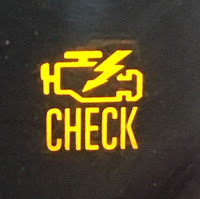

    This is a magical light because it helps me make the money I send to City of Longmont. Most of my career has been about keeping Check Engine Lights  (CEL) off, usually it's in big trucks and heavy equipment. But the light comes on in my 2000 Audi A4  so I wanted to learn more about it.

    I've owned my Audi since '17 so I've had some time to get into it. I had to put an engine in it, I've replaced brakes and wheel bearings. Plus I've chased some electrical issues. I've got most everything under control, everything except the CEL and the singular code that it throws # 0441. 

    The CEL was introduced when computers were added to engines. The computers were added to help control the emissions components. Basically cars and trucks and bulldozers all have emissions devices to help them run cleaner. It's one step in lowering greenhouse gasses and it's been extremely successful. The only issue is that things wear out. Screws come loose, shoelaces snap, eventually everything breaks down it's called entropy. So back to my 22 year old car and code # 0441. This is a generic code that means the same thing to every manufacturer. Audi defines it as "EVAP System Incorrect Purge Flow."

    Until the 1970's  gas tanks just had a hole at the top to act as a vent. This worked to let air in and out of the tank but it also bled fuel vapors into the air. To clean things up a system was added to catch those vapors and then add them back to the engine when the car was driving along. This is the EVAP system, it's the one mentioned in the code description.


    The basic idea of the system is that fuel vapors vent off the fuel tank and get trapped in a canister filled with charcoal. This EVAP canister is in the rear of the car in a little compartment under the spare tire.


    When it's the right time to suck this vapor into the engine, the ECM commands the purge valve to open. The purge valve is a little solenoid valve located on the air filter housing. This valve is very cheap, ($13) it's easy to access and easy to test. Most internet results for this code list the valve as a potential source of the problem. Either this or a leaking gas cap. These two parts are what you call 'low hanging fruit,' it's really easy to replace them, and it's possible it could solve the problem.  Unfortunately after you pick this low hanging fruit, the tree goes much, much higher.

    When engineers designed all these pollution control devices they also created On Board Diagnostics. This gives the vehicle the ability to test it's own components and determine if there are any failures. My Audi runs a leak check on this EVAP system when the conditions are right. The car has to be warmed up to temp and it has to be idling for about a minute. Typically this happens while I'm waiting at a light. When the ecm initiates the EVAP leak test, it leaves the purge valve closed. Then it cycles the leak detection pump or LDP.
This LDP  is located in the left rear wheelwell of my wagon.


    When the pump kicks on it pulls air through this paper filter and pressurizes the EVAP system to a specific amount. If the correct pressure is reached a small switch in the pump triggers and the ECM begins counting how long the system can hold the pressure. This is the crux moment. This is the point where my car passes the test in the summer, and fails in the winter. I have the dreaded 'intermittent' failure. The pump kicks on, ECM runs the test and the pressure bleeds off too fast. Then the CEL comes on and a #0441  code is logged.

    The trouble is....I don't really care that much about this failure. It's not my purge valve or my gas cap, it's none of the low hanging fruit. There is a lot of branches I could go after next. I could throw a vapor canister at it or an LDP, both are around $300 a piece. And that might not even fix it. I looked at all my vapor lines and didn't see any damage. But that doesn't mean one of these little hose clamps isn't leaking just a bit when it gets cold. Every connection is done with these crimped clamps, I could cut them off and replace them with hose clamps.


    I could do better diagnostics. I could jump power to the LDP and try to pressurize the system myself. Then I could check for leaks with soapy water or I could use a fancy smoke leak detector. But the thing is...I still don't care. My car passes emissions because this fault doesn't happen  when they run it on the dyno. 

    A check engine light is infuriating though, so I learned how to keep it off. When I'm sitting at a light, I prevent the ECM from running it's self check. I mentioned that it runs the test when the engine sits at idle for about a minute. The cure is to not leave it at idle over 45 seconds, I just tap the throttle once in a while as I wait at the light and it cancels the test. So, If you hear the lowered Audi wagon rev its engine just a little bit sitting next to you at a light, it doesn't mean he wants to race. He's just keeping his check engine light off.

Comments

Popular posts from this blog

When disk brakes attack

 The first time I saw a brake rotor draw blood was with my old dog Seamus . Seamus loved to chase bikes, he was a great dog.  A black and white border collie lab, he was born in Crested Butte and later honed his bike dog skills on the singletrack trails of Bend, Oregon.   I wouldn't say he was cuddly and loving, he was more like a heroin junkie jonzing for a fix. As soon as he saw me or any other human he would find some item to drop at your feet and begin begging you to throw it. He would lift the stick or slimy tennis ball up and try to spit it into your hand. If you hid the ball he would find a stick. If you hid the stick he'd find a rock. He was relentless. His lower teeth were chipped and broken from his fetching habit and he kept himself in constant motion, desperate to chase or retrieve. He was a dock jumper, frisbee catcher and bike chaser. The first bike he learned to chase had Vee brakes. So neither of us were expecting what happened when he chased me on my...

What we pass on

 I was fortunate enough to meet some friends for a Valmont riding session the other day. I've known Jesse since the pre-child days and now both of us are fathers. My girls are both skilled bike riders but they really accell at the sportsball activities. They have inherited the gene for team ball sports from their mother. Jesse's son on the other hand is a cycling prodigy. He flows with incredible style over the biggest jump lines or across the finish line. At one point Jesse and another dad split for the slopestyle line and I went with the boys over to the trick jump. I may have mentioned before that I believe tricks are an important aspect of jumping bikes. I just think if you're going to jump bikes, why not do some tricks? The alternative route for progression is to just keep jumping bigger and bigger jumps and this can lead to a plateau with severe consequences. To me a cool trick on a medium size jump is more impressive than a dead sailor over a massive jump. Basically,...

When did mountain biking become great?

 Yesterday I joined a birthday ride to celebrate a good friend's 45th. He rallied six of us into an epic day that went off perfectly. The local dropped expert trail knowledge. Every rider stepped up to new and intimidating challenges, and the guy who always crashes had a spectacular OTB right in front of me! Back at the trailhead beers and hotdogs galore were waiting for us. For the next several hours the hotdogs glistened and biking stories were told. Everyone crushed the techy ten mile ride so I was surprised to learn that most of the crew had started mountain biking during or just before Covid. Me and the other Gen Xer were the only lifetime riders.  A few hotdogs in, one mustached millennial posed the question, "So when did mountain biking get good?" It's a great question. Especially if your first bike is a carbon 29er with a dropper and a 1x drivetrain.  The other old guy started describing a specific point in full suspension development but I disagreed.  I decl...